
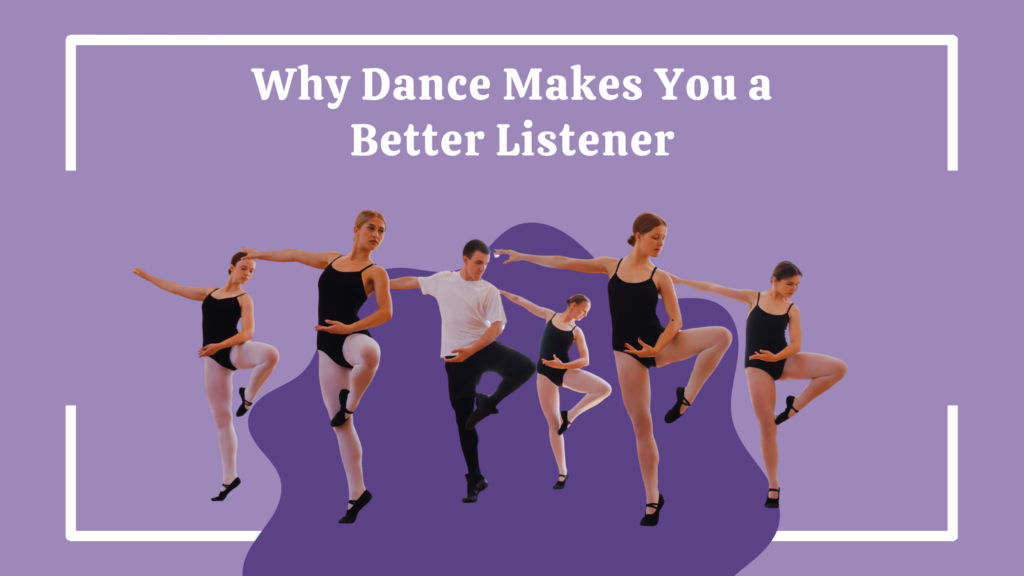
A dancer hears the music start. But they’re not simply listening to the song.
They’re noticing the beat, waiting for a cue, remembering what comes next, listening for instructions and staying aware of everyone moving around them.
That’s a lot of listening happening at once!
Dance naturally teaches students to pay closer attention to what they hear and respond to it. Over time, those skills can become useful well beyond the studio.
You Start Hearing More Than Just the Music
When you first hear a song, you might notice the lyrics or the main beat. A dancer learns to listen a little deeper.
There might be a change in tempo, a quiet pause, a particular instrument or a beat that signals the next movement.
Learning to recognise these details develops musicality, which is the ability to connect movement with the rhythm, mood and structure of music.
Instead of simply dancing while music plays, students learn to move with it.
Listening and Moving Have to Happen Together
Imagine your teacher gives you a new combination.
You need to hear the instructions, watch the demonstration, remember the order and then translate all of that information into movement.
And sometimes you only get a few moments before it’s your turn to try!
This encourages dancers to listen with purpose. Rather than simply hearing what someone says, they learn to pick out important information and act on it.
Corrections Teach You to Notice the Details
“Straighten your knee.”
“Relax your shoulders.”
“Wait for the music.”
Small corrections can completely change a movement.
Dancers gradually learn that details matter, so they become more aware of exactly what their teacher is asking them to change.
Even better, a correction doesn’t always have to be directed at you. Listening while another student receives feedback can give you something useful to check in your own dancing too.
Group Dancing Adds Another Layer
Listening becomes even more interesting when you’re dancing with other people.
Students need to stay aware of the music and choreography while also noticing their group. Everyone may need to begin together, change formation on the same count or react to another dancer’s movement.
That requires concentration, communication and awareness.
It also teaches an important lesson: being a good listener isn’t always about waiting quietly for your turn to speak. Sometimes it’s about noticing what’s happening around you and adjusting accordingly.
Those Skills Don’t Stay in the Studio
The listening habits developed through dance can be useful in everyday situations too.
Following several instructions, concentrating when someone is explaining something and noticing small details are all skills children use at school and throughout daily life.
There’s a creative side to this as well. Studies have shown that dance can support creative thinking and problem-solving skills. Dancers are regularly asked to remember information, respond to changes and work out how different movements fit together. When choreography changes or something doesn’t quite work, they need to listen, adapt and try another approach.
Dance gives students a fun and active way to practise these skills without it feeling like another lesson at a desk.
And because dancers regularly have to listen, remember, respond and adapt, they’re exercising those skills every time they step into class.
Listen, Learn and Move
Becoming a better dancer involves much more than remembering where your feet should go. It means learning to listen carefully, understand what you’re hearing and turn that information into action.
At Arabesque School of Performing Arts, students have the opportunity to develop their musicality, concentration and confidence while learning new skills and enjoying movement.
Come and try one of our classes at Arabesque School of Performing Arts and discover just how much there is to hear, learn and enjoy in a dance class.